


Regensburg: A Bavarian Pearl on the Danube and Odesa’s Twin City
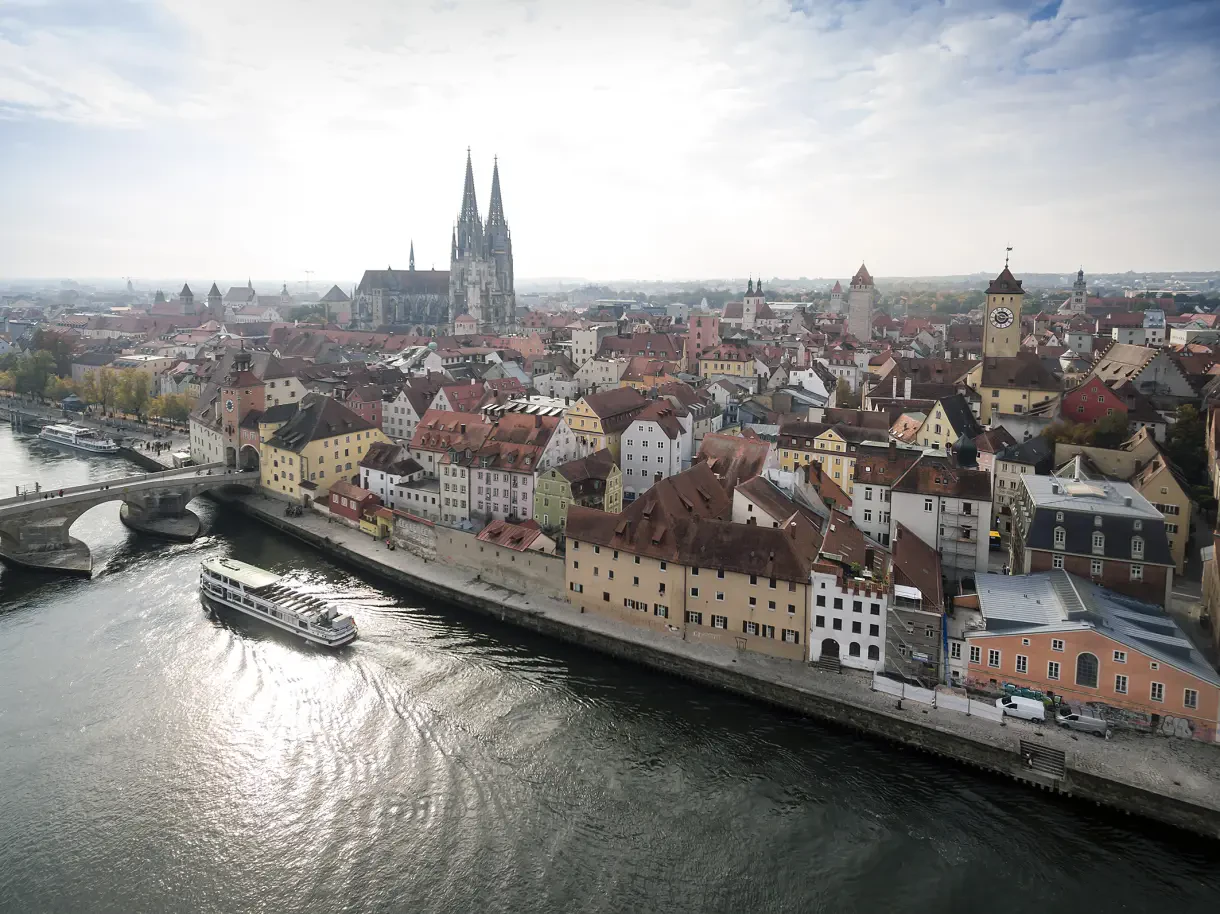
Regensburg is the largest German city on the Danube and one of Europe’s most remarkable historic urban centres.
Its importance is defined not only by its two-thousand-year history, its exceptionally preserved medieval old town and its role in the development of Bavaria, but also by its special place within the wider system of Danube connections — cultural, trade, infrastructural and municipal.
The history of Regensburg dates back to Roman times. In 179 AD, during the reign of Emperor Marcus Aurelius, the Roman military camp Castra Regina was established on the site of an earlier Celtic settlement. Parts of its remains have survived to this day, recalling the city’s role as a northern stronghold of the Roman Empire on the Danube. Geography became one of the key factors behind Regensburg’s development: the city is located near the northernmost point of the Danube, where the river forms a natural corridor between Central and South-Eastern Europe.
In the Middle Ages, Regensburg became one of the most important trade centres in Europe. Around the year 1000, its population reached approximately 40,000 people, making it one of the largest cities in Europe at that time. For centuries, Regensburg remained a political and economic centre of Bavaria, until Munich gradually assumed this role.
A decisive moment in the city’s development was the completion of the Stone Bridge in 1146. This engineering structure provided a reliable crossing over the Danube and opened new opportunities for trade between Northern Europe and southern commercial centres, including Venice. The Stone Bridge became not only an architectural symbol of Regensburg, but also a key instrument of its economic growth. For more than eight centuries, it remained the main crossing over the Danube within the city.
In 1245, Regensburg acquired the status of a Free Imperial City of the Holy Roman Empire. From that point onward, its role gradually shifted from that of a purely commercial hub to a space of political representation, legal decisions and interregional dialogue. In this sense, Regensburg became one of those Danube cities where the river performed not only a transport function, but also a civilisational one — connecting territories, institutions and cultural traditions.
For Ukraine, Regensburg also has a special symbolic significance. It is a twin city of Odesa, and this partnership has for more than three decades formed a stable channel of municipal, humanitarian, cultural and educational cooperation. For Odesa, as a Black Sea and Danube regional centre, such cooperation is important not only in the context of city diplomacy, but also within the broader logic of the European integration of Ukraine’s South.
The partnership between Odesa and Regensburg demonstrates that Danube Europe is not only a network of ports, bridges and transport corridors. It is also a space of trust between communities, universities, civil society organisations, cultural institutions and local self-government. Such horizontal links form the foundation of practical European cooperation, especially at a time when Ukraine is strengthening its participation in Danube initiatives.
Today, Regensburg’s importance for Danube cooperation lies in its combination of historical heritage and modern European municipal policy. The city is an example of how river identity can be used for the development of tourism, the preservation of cultural heritage, academic exchanges, urban planning and international partnerships.
For the Institute for Danube Research, the example of Regensburg is important in several dimensions. First, it shows that cities on the Danube can be not peripheral territories, but centres of political, economic and cultural gravity. Second, Regensburg’s experience confirms the importance of historical heritage as a resource for development. Third, its partnership with Odesa creates an additional basis for deepening Ukrainian-German dialogue within the broader Danube strategy.
Regensburg is not merely a Bavarian pearl on the Danube. It is a city that demonstrates how a river can connect eras, regions and communities. For Odesa and the Ukrainian Danube region, this experience has particular value: it reminds us that the true strength of the Danube region lies not only in infrastructure, but also in the ability of cities to build long-term partnerships based on shared history, mutual support and a European vision of the future.