

PPC Group and Metlen to Develop Energy Storage Projects in Romania, Bulgaria and Italy
 Romania
09.03.2026
Romania
09.03.2026
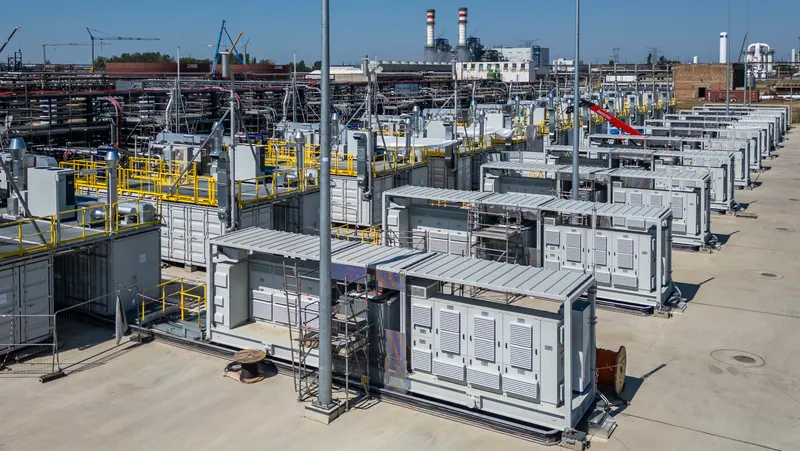
Greek energy companies PPC Group and Metlen Energy & Metals have signed an agreement to establish a joint venture for the development, construction, and operation of a portfolio of battery energy storage system projects in Romania, Bulgaria, and Italy. The portfolio is planned to reach a total nominal capacity of up to 1,500 MW / 3,000 MWh, with 1,000 MW expected to be implemented within the next 12 months. The projects will use two-hour liquid-cooled battery systems based on LFP technology. Under the agreement, PPC Group will be responsible for project development and energy management, while Metlen will oversee construction.
This agreement appears to be a logical continuation of the broader partnership already developed by the two companies. Recent reporting indicates that PPC and Metlen are increasingly building a regional cooperation model in which renewable generation and energy storage are treated as mutually reinforcing parts of the same energy infrastructure framework. In practical terms, this means that the focus is shifting from the simple expansion of installed renewable capacity to the creation of more flexible and resilient electricity systems.
Comment by IDR experts
Experts at the Institute of Danube Research note that the creation of such a BESS portfolio is a clear sign that Southeast Europe is entering a new phase of energy transition. While the previous stage was largely focused on adding new solar and wind generation, the current priority is increasingly becoming system flexibility, peak-load balancing, and the integration of variable renewables into electricity markets.
From the perspective of IDR analysts, it is particularly important that Romania and Bulgaria are included in this portfolio, as both countries are highly relevant to the energy architecture of the Danube-Black Sea area. The development of storage systems in these states may strengthen not only their domestic resilience, but also the overall reliability of regional cross-border energy linkages in a context of decarbonization, growing renewable penetration, and elevated security risks in Eastern Europe. This is an analytical inference based on the location of the projects and the role of storage in power system stability.
IDR experts emphasize that such projects should no longer be viewed as an auxiliary element of the energy sector, but rather as critical next-generation infrastructure. Energy storage is increasingly becoming the enabling component that connects investments in renewable generation, grid stability, trading flexibility, and the power system’s capacity to adapt to crisis scenarios.
“At the level of the Danube Region, this is more than a corporate agreement between two major players. It reflects the formation of a new configuration of energy resilience, in which storage systems become just as important as new generation capacity. Romania and Bulgaria are gradually emerging as key platforms for this transformation and, consequently, as important nodes in the future architecture of regional energy security.” This conclusion is based on the scale of the announced portfolio and the strategic role assigned to storage in supporting renewable generation and power system stability.
Overall, the new partnership between PPC Group and Metlen can be seen as an important signal for the wider space stretching from the Balkans to the Lower Danube: the energy transition in the region is entering a phase in which competitiveness will depend not only on the volume of new renewable projects, but also on the ability of countries to integrate storage, flexibility, and cross-border coordination into a single development model.

 Bulgaria
 Hungary

 Ukraine
 Moldova
 Serbia
 Danube