

Education Centre for the Languages and Cultures of the Danube Region’s National Communities to Open in Izmail
 Ukraine
26.08.2026
Ukraine
26.08.2026
The cultural and educational project “Languages of the Danube Region: Education, Dialogue, Unity” was launched in Izmail on Ukraine’s Independence Day. As part of the initiative, an Education Centre for the Languages of the Danube Region’s National Communities will open at Izmail Gymnasium No. 14.
Children from across the city will be able to study the Romani, Romanian and Bulgarian languages and explore the literature, culture and traditions of these communities. Izmail Mayor Andrii Abramchenko announced the establishment of the centre.
The project is being implemented by the Khamoro Roma Organisation, headed by Stepan Chebotar, with the support of the Council of Europe. The initiative aims to preserve the linguistic and cultural diversity of the Ukrainian Danube region, promote intercultural dialogue, overcome stereotypes and ensure equal access to education.
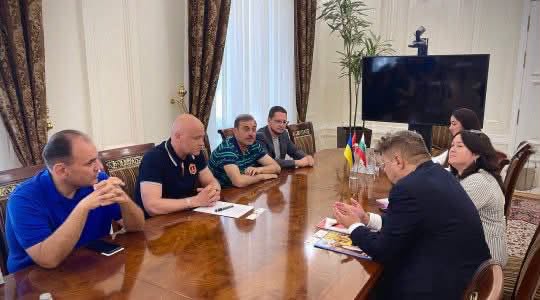
The establishment of the centre was discussed on 24 August during the round table “Authorities — Education — Community: Strategy and Barriers to Equal Access to Education”, held at Izmail State University of Humanities.
Deputy Mayor of Izmail Serhii Luzanov emphasised that cultural diversity is an important asset of the region and that learning the languages of national communities provides a deeper understanding of their cultures.
Project manager Stepan Chebotar noted that the centre should become a space where children can not only study languages but also learn about different traditions, identify shared values and develop the ability to engage in dialogue.
A separate component of the project will involve literary readings in Bulgarian, Romanian and Romani. Three events are planned with the participation of representatives of national communities, children and their parents.
The initiative also provides for the establishment of a working group comprising representatives of the municipal authorities, educational institutions, civil society organisations and relevant experts. It will develop a concept for a municipal programme supporting national communities and national cultural associations.
Training sessions will be organised for educators, psychologists, school administrators, public officials, volunteers and representatives of civil society organisations. They will address civic participation, advocacy for the rights of national communities, intercultural dialogue, the teaching of languages and cultures in schools, and the preparation of grant projects.
The project team intends to continue operating the centre after the current initiative is completed, expand its activities and gradually include the languages and cultures of other national communities living in the Ukrainian Danube region.
Comment by the Institute of Danube Research
The Ukrainian Danube region has historically developed as a multi-ethnic and multilingual area where interaction between different cultures contributes to social resilience. The establishment of the education centre in Izmail will support not only the preservation of linguistic heritage but also the development of mutual respect and responsible citizenship among children.
It is particularly important that the project combines educational, cultural and institutional components. Developing a municipal programme to support national communities could transform an individual civic initiative into a systematic local policy. This experience deserves to be replicated in other multi-ethnic communities across the Danube region.
Vitaliy Barvinenko, Director of the Institute of Danube Research and former Member of the Verkhovna Rada of Ukraine representing the region:
“For the Danube region, linguistic and cultural diversity has never been a dividing line but rather a foundation for mutual understanding. Children need to know their families’ traditions while also recognising themselves as part of a united Ukrainian civic nation. Initiatives of this kind strengthen both local communities and the unity of Ukraine.”

 Bulgaria
 Hungary
 Romania
 Moldova
 Serbia
 Danube