

Vertical Gas Corridor Gains Momentum as Capacity Demand Exceeds Expectations
 Romania
13.07.2026
Romania
13.07.2026
The first long-term auctions for booking capacity along the Vertical Gas Corridor have demonstrated strong interest from participants in the European energy market. The results confirm that the route is gradually evolving from an infrastructure initiative into a commercially viable channel for supplying natural gas to the countries of South-Eastern and Central Europe.
According to the Greek gas transmission system operator DESFA, the highest demand was recorded at the Sidirokastro interconnection point on the Greek-Bulgarian border.
For the 2026/2027–2029/2030 gas years, market participants booked approximately 46% of the available export capacity. For the 2030/2031 gas year, around 26% was reserved. In total, 100 GWh of daily export capacity was offered at the Sidirokastro point.
Certain volumes were booked as far ahead as the 2040/2041 gas year. Such a long-term horizon indicates that companies expect demand for gas transportation from southern to northern Europe to remain strong over the coming decades.
Among the active market participants are Atlantic Sea LNG Trade, a joint venture established by the Greek companies Aktor Group and DEPA Commercial, as well as the energy company Metlen. Atlantic Sea LNG Trade is developing LNG supply routes through Greece to Central European countries and Ukraine.
The Vertical Gas Corridor provides for the transportation of gas from the Greek LNG terminals at Revithoussa and Alexandroupolis, as well as from the Southern Gas Corridor, through the gas transmission systems of Bulgaria, Romania and Moldova toward Ukraine, Hungary and Slovakia.
The project is based on the use and modernisation of existing cross-border pipelines, the development of reverse-flow capacity and the introduction of coordinated capacity products and tariffs among gas transmission system operators.
In March 2026, operators from Greece, Bulgaria, Romania, Moldova and Ukraine, with the participation of the European Commission, agreed on a new tariff model designed to make gas transportation through the Vertical Corridor more competitive. The model envisages daily, monthly, quarterly and annual capacity booking products.
Greece, Bulgaria, Romania, Hungary, Slovakia, Ukraine and Moldova are already involved in the initiative. Preparations are also underway for North Macedonia and Serbia to join through the construction of new interconnectors. This is expected to create an additional Balkan branch of the corridor and strengthen the interconnection of regional gas markets.
The geographical expansion of the project has not only infrastructural but also political significance. The integration of the Western Balkan energy systems with the EU market could become one of the practical mechanisms for their gradual inclusion in the common European energy area.
The growing role of the Vertical Gas Corridor comes as the European Union implements its policy of gradually phasing out Russian energy resources.
The EU has already approved a gradual ban on Russian gas imports. Under the adopted approach, imports of Russian liquefied natural gas are expected to end by the close of 2026, while pipeline gas imports are to be discontinued in autumn 2027.
Under these conditions, the countries of South-Eastern and Central Europe need access to alternative sources of supply. The Vertical Corridor enables the transportation of LNG arriving at Greek terminals, as well as gas from the Caspian region, toward the Balkans, Central Europe, Moldova and Ukraine.
At the same time, high levels of capacity booking do not automatically mean that Russian gas will be fully displaced. The commercial success of the route will depend on LNG prices, transportation tariffs, access to terminal capacity, the modernisation of cross-border connections and stable demand across the region.
For Ukraine, the Vertical Gas Corridor creates an additional gas import route through Greece, Bulgaria, Romania and Moldova. It may be used to cover seasonal shortages, build reserves in underground storage facilities and strengthen the resilience of the energy system amid Russian attacks on gas production and transportation infrastructure.
The corridor also opens prospects for European traders to use Ukraine’s underground gas storage facilities. Due to its substantial storage capacity, Ukraine could serve as a regional balancing hub between southern LNG supply routes and consumers in Central Europe.
The project is equally important for Moldova. It expands the country’s opportunities to receive gas through the Romanian and Greek gas transmission systems, strengthens competition among suppliers and reduces dependence on a single import route and source.
Comment by the Institute of Danube Research
Experts of the Institute of Danube Research note that the results of the first auctions represent an important indicator of market confidence in the Vertical Gas Corridor.
“Capacity bookings for several years, and in some cases for decades ahead, demonstrate that market participants view the corridor not as a temporary crisis-response mechanism, but as a potentially permanent component of Europe’s emerging energy architecture.
For Ukraine and Moldova, this means broader access to Greek LNG terminals, greater flexibility in import operations and reduced dependence on traditional eastern routes.
At the same time, the full operation of the corridor requires coordinated tariff policies, completion of interconnector modernisation and sufficient transmission capacity along the entire route—from the Greek terminals to the Ukrainian border,” the Institute emphasised.
The connection between the corridor and Ukraine’s underground gas storage facilities will also be of particular importance. This could transform Ukraine from a final consumer of imported gas into a major regional centre for its storage, balancing and subsequent supply.
According to Vitaliy Barvinenko, Director of the Institute of Danube Research:
“The Vertical Gas Corridor is creating a new energy axis from the Aegean Sea to Ukraine. Its strategic value lies not only in replacing Russian gas, but also in building a competitive, interconnected and resilient market in which no country depends on a single supplier or a single route.”
The high demand recorded during the first auctions has confirmed the commercial interest in the project. The next test will be whether the participating countries can rapidly complete the necessary infrastructure works and ensure competitive gas transportation costs along the entire corridor.

 Bulgaria
 Hungary
 Ukraine
 Moldova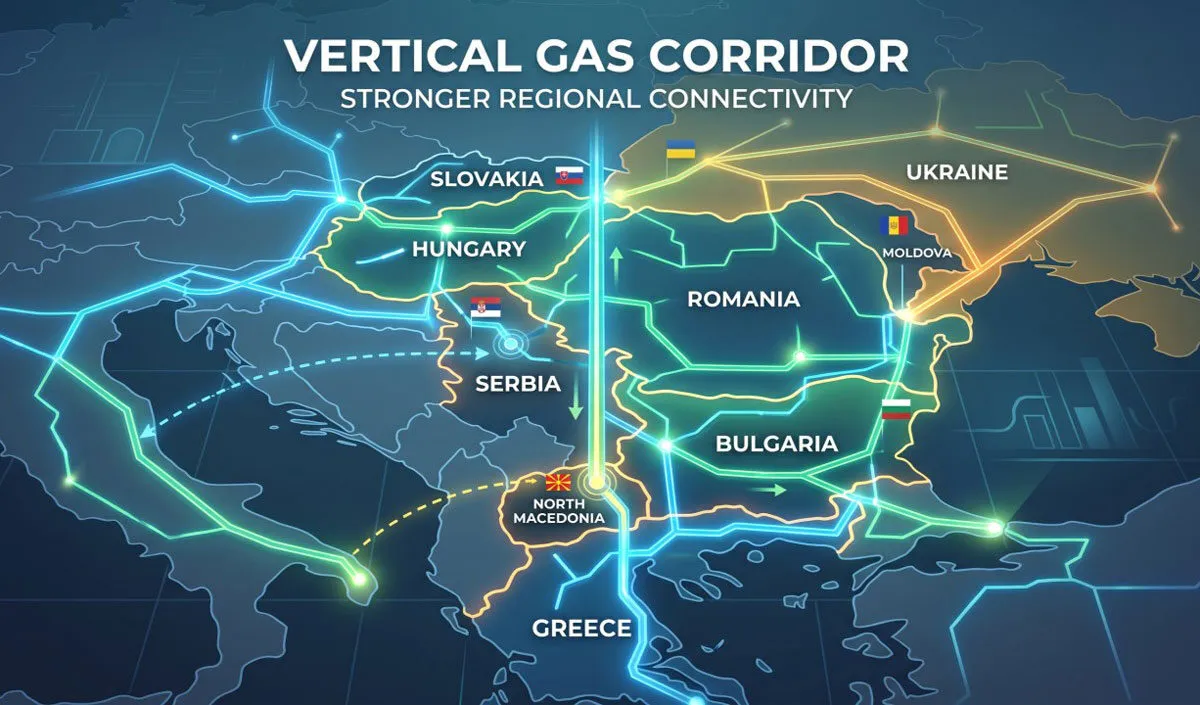
 Serbia
 Danube